
7 Mistakes to Avoid When Choosing a Landing Page Builder
Published Jul 04, 2026 | Updated Jul 04, 2026
Selecting a landing page builder may seem straightforward, but the wrong choice can create unnecessary costs, slow down marketing campaigns, and limit future growth. Businesses often focus on attractive templates or low pricing while overlooking the features they will actually need as their campaigns evolve.
Whether you’re managing a single brand or multiple clients, taking the time to evaluate your options can prevent headaches later. Here are seven common mistakes to avoid when choosing a landing page solution.
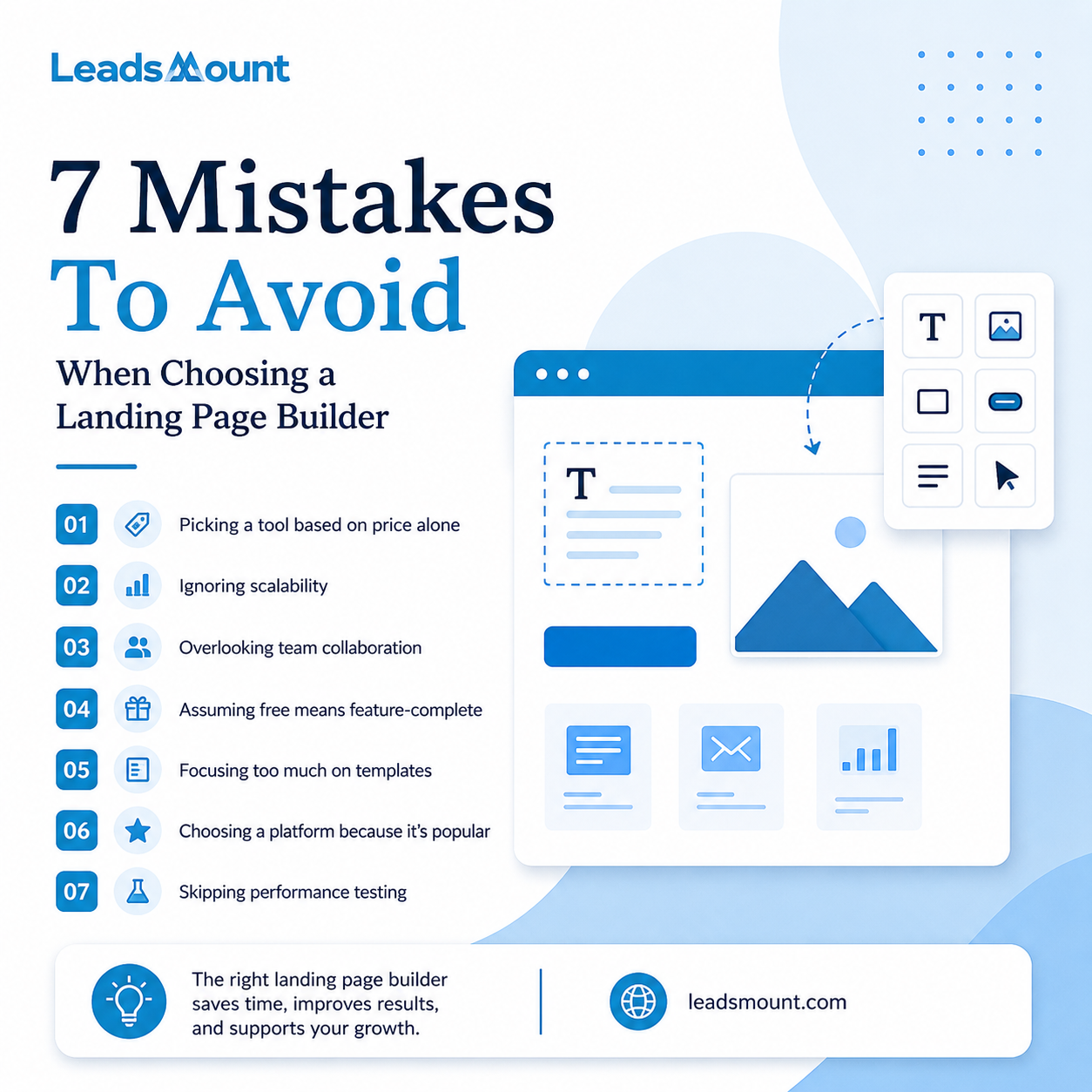
- 1. Picking a Tool Based on Price Alone
- 2. Ignoring Scalability
- 3. Overlooking Team Collaboration
- 4. Assuming Free Means Feature-Complete
- 5. Focusing Too Much on Templates
- 6. Choosing a Platform Because It’s Popular
- 7. Skipping Performance Testing
- Key Features Worth Prioritizing
- Questions to Ask Before You Commit
- Final Thoughts
- Frequently Asked Questions (FAQs)
1. Picking a Tool Based on Price Alone
Budget is an important consideration, but it shouldn’t be the only factor. A platform with a low monthly fee may lack essential features such as integrations, analytics, or testing capabilities. On the other hand, paying for advanced functionality that your team never uses can also be wasteful.
Instead of asking, “What’s the cheapest option?” ask, “Which platform provides the best value for my workflow?”
2. Ignoring Scalability
Many businesses start with a handful of campaigns and quickly expand. A platform that works well today may become restrictive when you need additional users, more landing pages, or higher traffic limits.
If growth is part of your plan, choose software that can support it without requiring a complete migration.
3. Overlooking Team Collaboration
Marketing rarely happens in isolation. Designers, copywriters, advertisers, and clients often need to review or edit pages before they go live.
This is especially important when searching for a landing page builder for agencies, where managing permissions, multiple workspaces, and client assets can significantly improve efficiency.
4. Assuming Free Means Feature-Complete
It’s understandable that many startups and freelancers begin with a landing page builder for free, especially when budgets are tight. Free plans can be excellent learning tools and may be sufficient for simple projects.
However, they often come with limitations such as branded domains, restricted integrations, or visitor caps. Understanding these constraints early helps avoid unexpected roadblocks when campaigns start gaining traction.
5. Focusing Too Much on Templates
A polished template can save time, but successful landing pages depend on messaging, user experience, and conversion optimization—not aesthetics alone.
Even a basic design can outperform an elaborate layout if it communicates value clearly and guides visitors toward a single action.
6. Choosing a Platform Because It’s Popular
Well-known software often receives attention because of its market presence, but popularity doesn’t guarantee the best fit for every organization.
Some marketers specifically look for an Unbounce alternative because they need different pricing structures or collaboration features. Others compare solutions in search of an Instapage alternative that better matches their technical requirements or business size.
The right platform should align with your goals rather than industry trends.
7. Skipping Performance Testing
Launching a page is only the beginning. Continuous improvement through testing can reveal better headlines, stronger calls to action, or simpler forms that increase conversions.
Organizations that regularly review performance data are more likely to improve campaign results over time than those that rely on assumptions.
Key Features Worth Prioritizing
When evaluating landing page software, look for capabilities that support both current and future needs:
- Drag-and-drop editing
- Mobile responsiveness
- Fast loading speeds
- Custom domains
- CRM and email integrations
- A/B testing tools
- Analytics dashboards
- Collaboration features
- Template flexibility
- Reliable hosting and uptime
Not every project requires every feature, but understanding what’s available helps you make a more informed decision.
Questions to Ask Before You Commit
Before subscribing to any platform, consider these practical questions:
- How easy is it for non-technical users to create pages?
- Will it integrate with your existing marketing stack?
- Can multiple people collaborate without confusion?
- Does it support future campaign growth?
- Are there hidden costs for traffic or additional users?
- How simple is it to update pages after publication?
These answers often provide more insight than feature comparison charts alone.
Final Thoughts
The best landing page builder isn’t necessarily the one with the longest feature list or the biggest marketing budget. It’s the one that supports your workflow, helps you publish campaigns efficiently, and gives you the tools to improve results over time.
By avoiding common selection mistakes and focusing on practical business needs, marketers can invest in a platform that remains useful long after the first landing page goes live.
Frequently Asked Questions (FAQs)
- What is the biggest mistake when choosing a landing page builder?
One of the biggest mistakes is selecting a platform based solely on price without considering features, scalability, integrations, and long-term business needs. - Why is scalability important in a landing page builder?
A scalable platform can support more campaigns, users, and traffic as your business grows, reducing the need to switch tools later. - Are free landing page builders good for businesses?
Free landing page builders can work well for testing ideas or small projects, but they often have limitations such as branding, restricted integrations, or usage caps. - Why should agencies look for collaboration features?
Agencies often manage multiple clients and team members, so collaboration tools, user permissions, and shared workspaces help streamline workflows and improve productivity. - Do landing page templates guarantee high conversions?
No. While templates can speed up design, conversion rates depend on factors like messaging, user experience, page speed, and calls to action. - Should I choose a landing page builder just because it’s popular?
Not necessarily. The best platform is one that fits your business goals, budget, and workflow rather than simply being widely used. - Why is A/B testing important for landing pages?
A/B testing allows you to compare different versions of a page to identify which headlines, layouts, or calls to action generate better results. - What features should I prioritize when selecting a landing page builder?
Look for drag-and-drop editing, mobile responsiveness, integrations, analytics, A/B testing, collaboration tools, fast loading speeds, and reliable hosting.