
Instapage Alternative: What to Look for in a Modern Landing Page Builder
Published Jul 21, 2026 | Updated Jul 21, 2026Landing pages are an essential part of digital marketing. Whether you’re running paid advertising campaigns, collecting leads, promoting a product, or launching a new service, a well-designed landing page can significantly improve conversion rates. While Instapage is a widely recognized platform in this space, it isn’t the only solution available. Businesses today have a growing number of options depending on their goals, budget, and workflow.
If you’re searching for an instapage alternative, it’s helpful to understand the features that matter most instead of focusing on brand names alone. This approach ensures you select a platform that aligns with your marketing strategy and long-term growth.
- Why Businesses Explore Alternatives
- Essential Features to Consider
- 1. No-Code Visual Editor
- 2. Responsive Design
- 3. Ready-to-Use Templates
- 4. A/B Testing
- 5. Analytics and Conversion Tracking
- 6. Third-Party Integrations
- Different Types of Landing Page Builders
- Factors Beyond Features
- Ease of Learning
- Publishing Flexibility
- Scalability
- Performance
- Best Practices for High-Converting Landing Pages
- Final Thoughts
- Frequently Asked Questions (FAQs)
- 1. What should I look for in an Instapage alternative?
- 2. Are there free alternatives to Instapage?
- 3. Can I create landing pages without coding?
- 4. Why is A/B testing important for landing pages?
- 5. Do landing page builders integrate with CRM and email marketing tools?
- 6. Are landing pages mobile-friendly?
- 7. How do I choose the right landing page builder?
- 8. Can I use a custom domain with a landing page builder?
Why Businesses Explore Alternatives
Every organization has different requirements. A platform that works well for a large enterprise may not be ideal for a startup or a growing agency. Common reasons businesses consider other landing page builders include:
- Budget constraints
- Need for simpler user interfaces
- Better collaboration features
- Flexible integrations
- Advanced analytics
- More customization options
- AI-powered content or design assistance
The right solution ultimately depends on how your team creates, publishes, and optimizes landing pages.
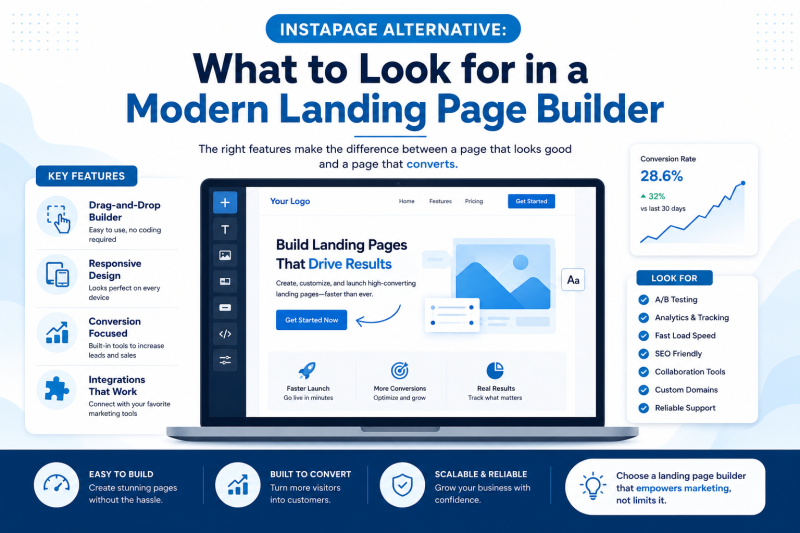
Essential Features to Consider
1. No-Code Visual Editor
A drag-and-drop editor allows marketers and business owners to create professional landing pages without relying on developers. This reduces turnaround time and enables faster campaign launches.
2. Responsive Design
Modern landing pages should automatically adapt to desktops, tablets, and smartphones. Since mobile traffic continues to grow, responsive design is no longer optional.
3. Ready-to-Use Templates
Templates help teams launch campaigns quickly while following proven design practices. Customization options should also be available for maintaining brand consistency.
4. A/B Testing
Testing multiple versions of a landing page helps identify which headlines, images, layouts, or calls-to-action produce better conversion rates. Continuous optimization is one of the most effective ways to improve campaign performance.
5. Analytics and Conversion Tracking
Understanding visitor behavior is essential for making informed marketing decisions. Built-in analytics or integration with external tracking tools allows businesses to measure campaign success accurately.
6. Third-Party Integrations
Landing pages rarely work in isolation. Integration with CRM systems, email marketing software, analytics platforms, and automation tools creates a more efficient marketing workflow.
Different Types of Landing Page Builders
Various platforms serve different audiences.
- Enterprise-focused platforms often prioritize personalization, collaboration, and scalability.
- Small business solutions usually emphasize affordability and ease of use.
- Agency-oriented builders provide workspace management, client collaboration, and multi-account capabilities.
- AI-powered builders help generate layouts, content, and design suggestions to accelerate page creation.
Understanding which category best fits your business can simplify the selection process.
Factors Beyond Features
While features are important, several practical considerations also influence the overall experience.
Ease of Learning
A platform should allow new users to become productive quickly without extensive training.
Publishing Flexibility
Support for custom domains, secure hosting, and fast deployment helps streamline campaign management.
Scalability
As marketing efforts expand, the landing page platform should support increased traffic, additional team members, and larger campaign volumes.
Performance
Fast-loading pages improve user experience and can positively impact both conversion rates and advertising performance.
Best Practices for High-Converting Landing Pages
Regardless of the platform you choose, successful landing pages typically follow several proven principles:
- Focus on one primary objective.
- Write clear and concise headlines.
- Keep forms as short as possible.
- Use a prominent call-to-action.
- Build trust with testimonials or social proof.
- Optimize images for faster loading.
- Test different page variations regularly.
- Ensure mobile responsiveness.
These practices often have a greater impact on conversion rates than the specific software being used.
Final Thoughts
The landing page software market has evolved considerably, giving businesses access to a wide variety of capable solutions. Rather than selecting a platform based solely on popularity, evaluate your workflow, team size, marketing goals, required integrations, and optimization capabilities.
A thoughtful comparison of available options will help you choose a landing page builder that supports efficient campaign creation, continuous testing, and long-term growth while meeting your specific business requirements.
Frequently Asked Questions (FAQs)
1. What should I look for in an Instapage alternative?
When comparing landing page builders, consider features such as a drag-and-drop editor, responsive templates, A/B testing, analytics, CRM integrations, page speed, and ease of use. The best choice depends on your business goals and budget.
2. Are there free alternatives to Instapage?
Yes. Several landing page builders offer free plans or free trials with basic features. However, advanced capabilities like A/B testing, custom domains, and premium templates are often available only on paid plans.
3. Can I create landing pages without coding?
Most modern landing page builders provide no-code drag-and-drop editors that allow users to create and publish professional landing pages without any programming knowledge.
4. Why is A/B testing important for landing pages?
A/B testing helps compare different versions of a landing page to determine which one performs better. Testing elements like headlines, images, and call-to-action buttons can improve conversion rates over time.
5. Do landing page builders integrate with CRM and email marketing tools?
Yes. Many landing page platforms support integrations with popular CRM systems, email marketing software, analytics tools, and automation platforms, making it easier to manage leads and marketing campaigns.
6. Are landing pages mobile-friendly?
Most modern landing page builders automatically create responsive pages that adapt to smartphones, tablets, and desktop devices, ensuring a better user experience across all screen sizes.
7. How do I choose the right landing page builder?
Evaluate factors such as ease of use, pricing, available templates, customization options, integrations, analytics, page speed, customer support, and scalability before making a decision.
8. Can I use a custom domain with a landing page builder?
Yes. Most premium landing page platforms allow you to publish pages on your own custom domain, helping maintain brand consistency and improve credibility.